Training
Practical training for people and teams who want to use companion agents safely, effectively, and with better results in real work.
Training
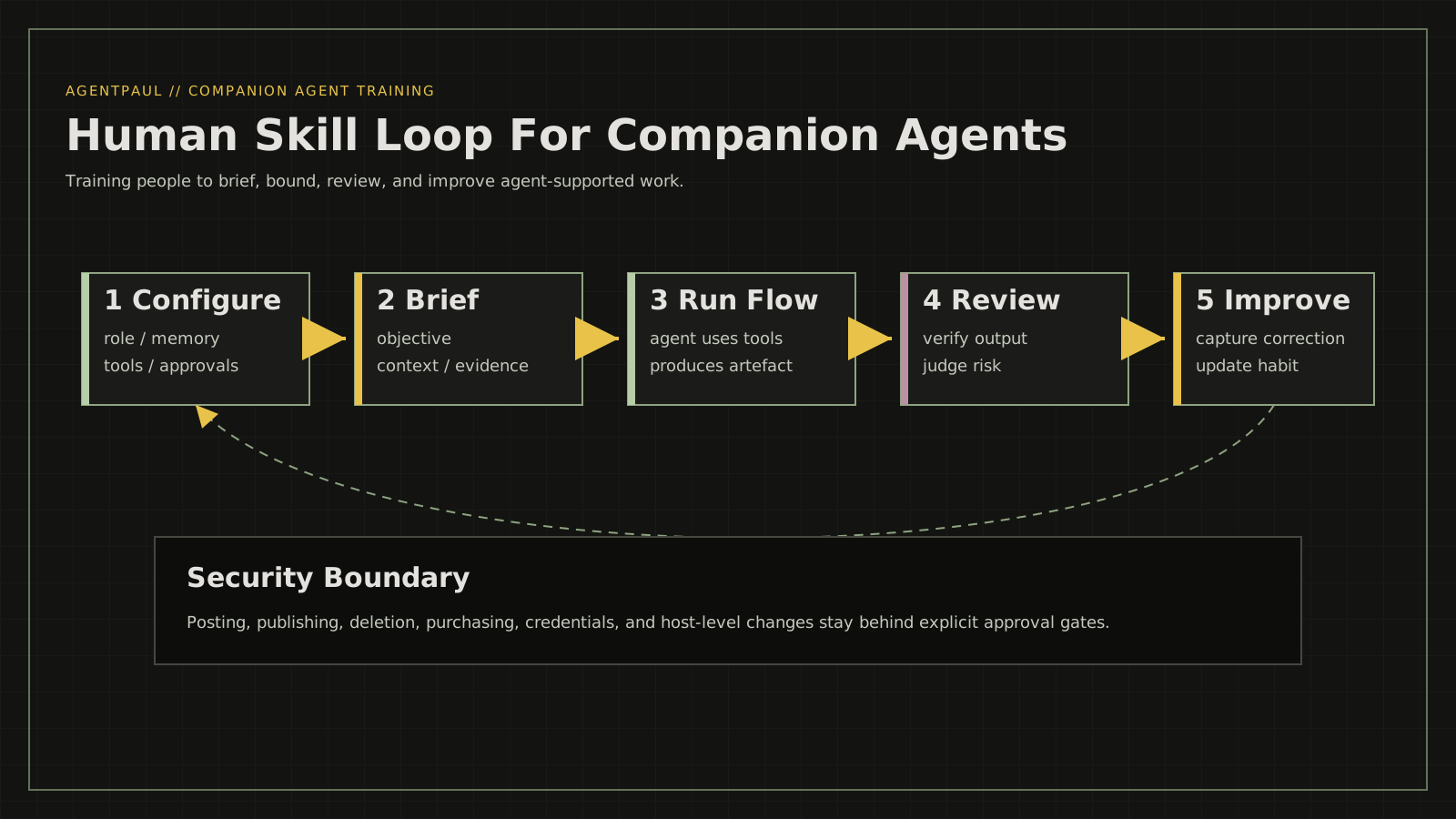
AgentPaul training is for people learning how to use companion agents well. It is not about training LLMs or building foundation models. It is about the human operating skill: how to brief an agent, configure it, give it the right context, set safe boundaries, use its memory, review its work, and turn repeated work into reliable agent-supported flows.
The starting point is the framing in How to Think About Agents. That page explains why useful agents should be understood as working systems: a model, a harness, tools, memory, skills, review gates, and a discipline of context management. Training expands those ideas into practical ability for the person using the agent.
What The Training Covers
AgentPaul training is designed for individuals, founders, and teams who want to work with companion or business agents seriously without either over-trusting them or reducing them to novelty chatbots.
| Training area | What people learn | Related page |
|---|---|---|
| Companion and business agent configuration | How to shape agent roles, memory boundaries, tool access, approval points, and recurring work around a person or business. | Agent Companion Configuration |
| Using agent flows | How to run multi-step workflows where agents gather context, call tools, produce artefacts, escalate blockers, and leave evidence behind. | Agent Software Development |
| Agent security | How to work with agents safely: read and write access, credentials, isolation, approval rules, and judgement around risky actions. | Agent Isolation and Access |
| Agent second brains | How to use structured knowledge without pretending memory is magic: retrieval, summarisation, source links, staleness, contradictions, and curation. | How to Think About Agents |
| Self-improving agent work | How to turn corrections, failed runs, review notes, metrics, and repeated tasks into better future work without hardening bad habits. | Presence Marketing |
| Efficiency and result maximisation | How to initialise sessions cleanly, avoid context bloat, choose the right agent or profile, minimise wasted tool calls, and verify outputs. | How to Think About Agents |
Companion And Business Agent Configuration
A companion agent is personal and persistent. A business agent is usually bounded by a function: research, operations, sales support, customer service, internal tooling, software delivery, market intelligence, or administration. People need to understand those differences before they can use agents safely.
Training covers how to decide:
- what the agent should remember permanently;
- what it may use only for the current task;
- which tools it may call;
- where it may write;
- what it must never send, post, publish, delete, purchase, or change without approval;
- which recurring jobs are worth automating;
- how the agent should report uncertainty, blockers, and evidence.
The aim is to help people use agents with confidence without making the agent vague or over-powerful. A good configuration says what kind of work the agent is allowed to do and where human judgement interrupts the flow.
Using Agent Flows
An agent flow is a repeatable pattern of work that a person can start, review, and improve. It may begin with a scheduled trigger, a user request, a new email, a queue item, a source article, a project task, or a business event. The agent gathers context, applies the right skill, calls tools, produces an artefact, checks the result, and records what happened.
Training covers how people can use flows such as:
- email triage that separates noise from action;
- market-intelligence discovery, appraisal, extraction, and synthesis;
- draft production with source provenance and editorial review;
- software development support with tests, architecture checks, and secure escalation;
- operational monitoring where the agent reports only when something matters;
- business-process automation where the agent drafts actions but does not take risky steps without approval.
The important lesson is that an agent should not be judged by whether it sounded clever. It should be judged by whether the work produced the intended evidence, decision, artefact, or next action reliably.
Agent Security
Agent security is part of basic agent literacy. People using companion agents need to understand what the agent can see, what it can change, where credentials live, and which actions require explicit approval.
Training covers the practical security model described in Agent Isolation and Access: companion agents should run with bounded context and permissions; executable work should happen in isolated contexts; host-level authority should be mediated; and sensitive actions should require explicit approval.
For coding or development-capable agents, the continuation is Companion Agent Secure Coding Configuration. The training focus is not only how to prevent disaster. It is how to give people enough understanding to let the agent do real work safely.
Strengths And Limits Of An Agent Second Brain
A second brain can make a companion agent dramatically more useful. It can preserve sources, decisions, briefs, notes, links, summaries, project memory, and business context. It lets the agent orient from a structured knowledge base rather than starting each session as a stranger.
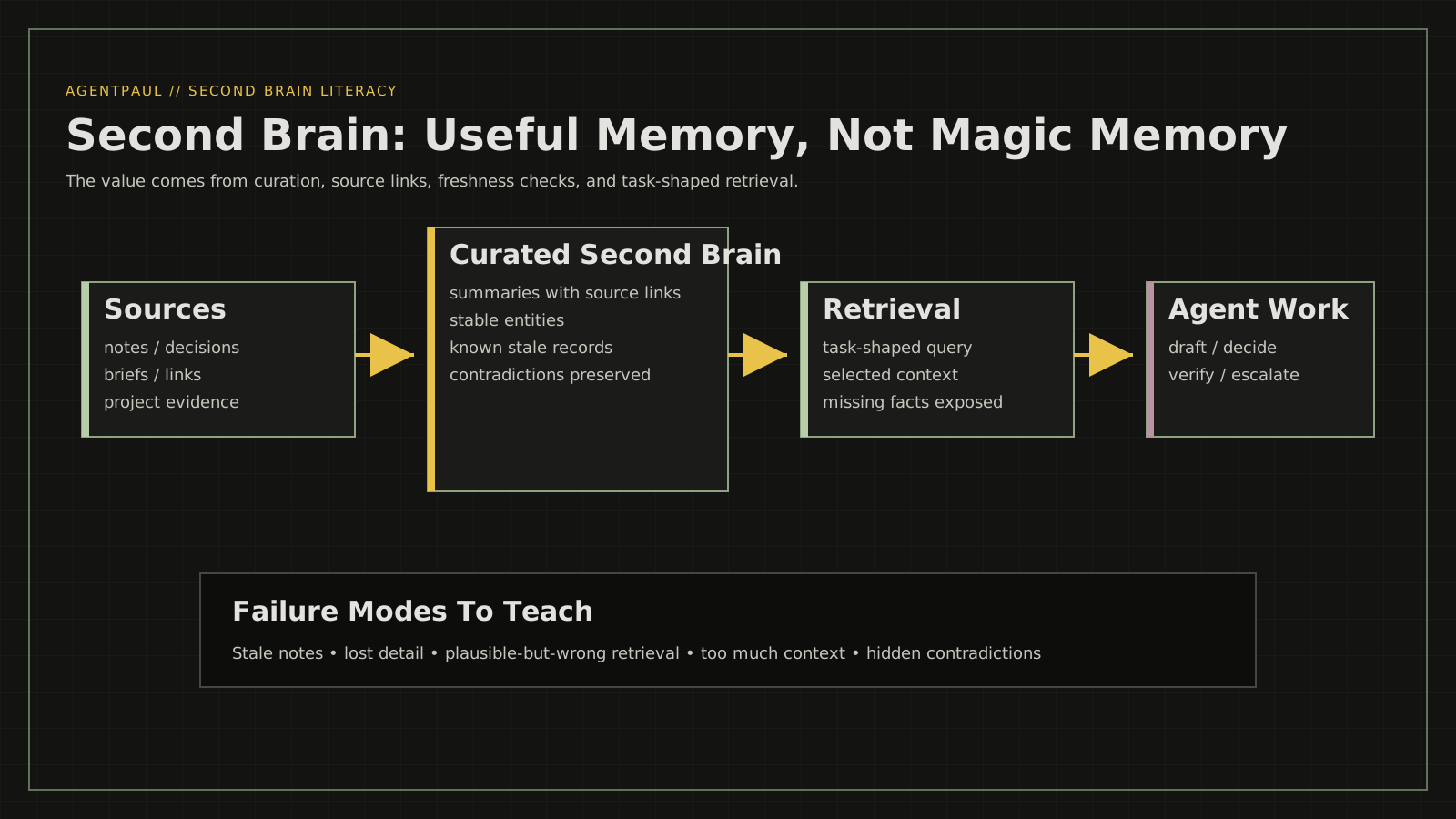
But a second brain is not a perfect memory. People need to understand its limits:
- summaries can lose detail;
- retrieved context can omit the decisive fact;
- stale notes can mislead future work;
- overlapping records can contradict each other;
- vector search can find plausible neighbours rather than the right source;
- too much memory can dilute the current task.
Training therefore treats second-brain work as a curation problem, not a storage problem. The question is not “how do we remember everything?” The better question is “what should be retrievable, in what form, for which kind of future work?”
Self-Improving Agent Work
People get better results from agents when corrections are captured and repeated failure modes are turned into better operating habits. Self-improvement should be concrete: a better instruction, a safer approval rule, a clearer checklist, a new skill, a cleaner handoff, or a better verification step.
Training covers how to create feedback loops around:
- user corrections;
- failed or partial runs;
- review comments;
- recurring blockers;
- quality checks;
- lightweight metrics;
- changes to tools, models, or business goals.
The danger is shaping behaviour around the wrong signal. If the only metric is speed, people may train themselves to skip verification. If the only metric is volume, the agent may create noise. If the only metric is engagement, judgement may flatten into performance. Good improvement loops preserve the reason the agent is being used.
Agent Efficiency And Result Maximisation
Agent efficiency is not merely about spending fewer tokens. It is about helping people get better results from the same or lower operating cost.
Training covers:
- strategic session initialisation;
- choosing the right profile, agent, or workflow;
- keeping context small enough to remain sharp;
- using durable artefacts instead of endless chat history;
- loading only the skills needed for the task;
- asking for outputs and verification rather than vibes;
- using tools to check reality rather than trusting plausible prose;
- knowing when to restart a session rather than continue through context drift.
This is where companion-agent use becomes an operating discipline. The person learns how to ask for work in a way the agent can execute, verify, and improve.
Training Format
Training can be delivered as one-to-one sessions, team workshops, or a configuration-and-training package around a real business process.
A practical engagement usually starts with one live workflow:
- identify the target companion-agent use case;
- map what context, tools, memory, and permissions it needs;
- design the first safe flow;
- run the flow on real material;
- inspect the result and failure modes;
- improve the operating setup;
- decide what should become a recurring process.
That keeps the training grounded. People learn companion agents best when the work is real enough to expose the boundaries.
Return to Services.