Agent Companion Configuration
How to configure a personal agent that can act as confidant, advisor, and life COO without blurring business, employment, and security boundaries.
Agent Companion Configuration
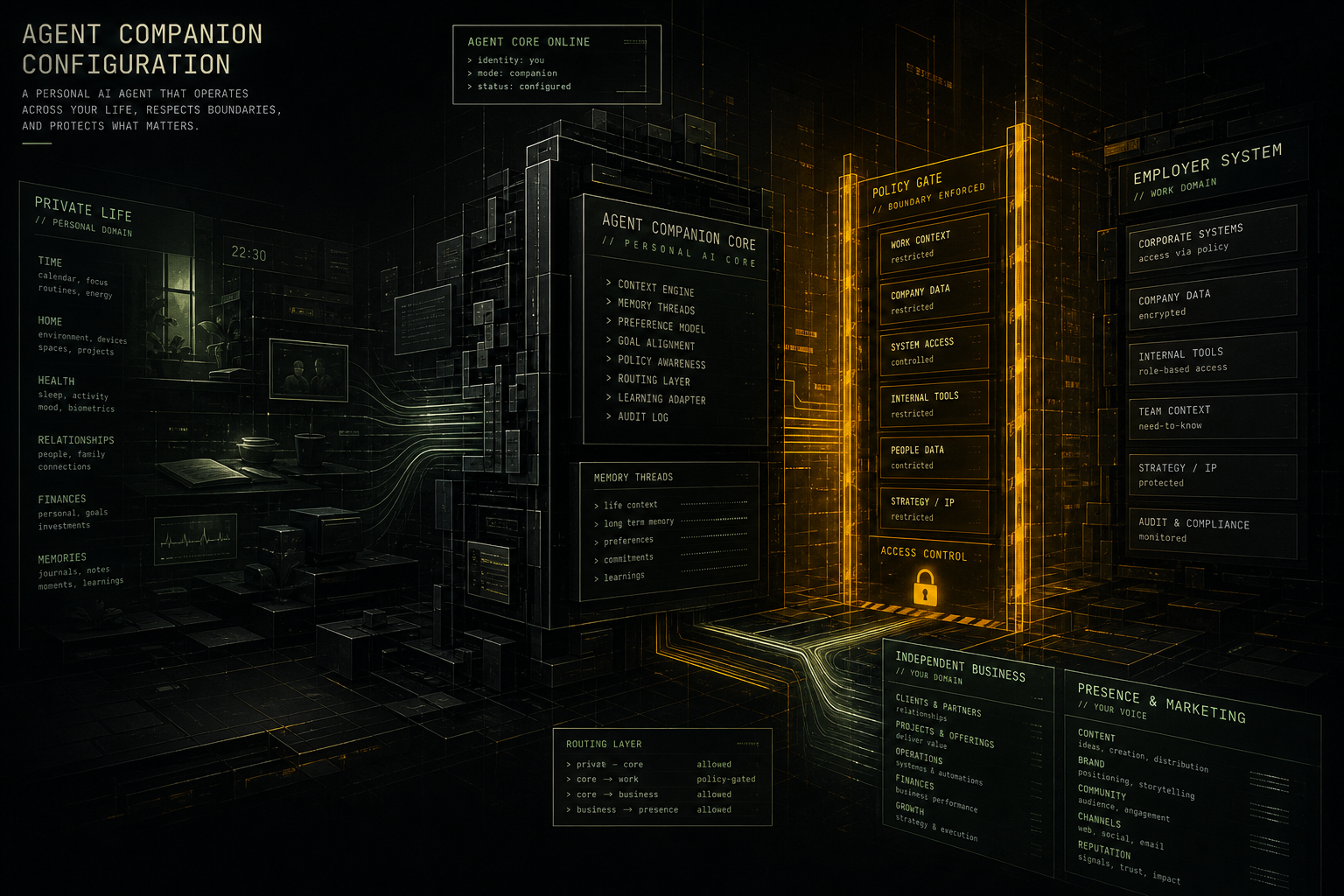
Agents now have something close to a chronological life. They can remember a trajectory, not just answer a question. They can hold context across projects, notice recurring patterns, challenge your assumptions, and help coordinate the messy overlap between work, learning, relationships, health, writing, business interests, and long-term ambition.
That is why the obvious metaphor is no longer the chatbot. It is the companion: a tireless confidant, advisor, and life COO. The thing closer to JARVIS than to a search box.
But the moment an agent becomes useful in that way, it also becomes dangerous if configured badly. A personal agent that understands your objectives, your professional habits, and your commercial interests sits on a boundary that most organisations have not yet defined. It is not simply a private productivity tool. It can become an unofficial interface between your personal judgement and your employer's systems.
That boundary needs deliberate design.
The business-personal boundary
Every serious professional already carries knowledge between contexts. Your employer cannot ask you to expunge your judgement, memory, taste, discipline, or accumulated process when you leave the office. You learn from work, and that learning becomes part of you.
A personal agent complicates this because some of that learning can now be mirrored outside your own mind. The grey area is not whether you are allowed to learn. The grey area is what can reasonably be captured, stored, recalled, and acted on by a private system.
The right question is not whether personal agents should exist. They will exist. The right question is where the boundary sits between legitimate personal continuity and inappropriate leakage of company information.
That boundary depends on the person, the employer, the industry, the regulatory environment, and the agent's actual capabilities. A copywriting assistant with no long-term memory is a different risk from an agent with filesystem access, email access, credential access, and a persistent model of your work patterns.
The questions to settle before configuration
Before configuring a serious agent companion, I would want clear answers to questions like these:
- Does your employer have a policy on using external AI systems for questions connected to company business?
- Are employees allowed to access AI tools from within the business environment?
- Are there approved AI tools, gateways, or logging systems already in place?
- Is the organisation bound by a specific AI or data framework, such as the EU AI Act, financial-services rules, healthcare privacy duties, professional secrecy, or client confidentiality obligations?
- What types of information are absolutely excluded from personal agent memory?
- What working practices can be abstracted safely as personal learning without capturing confidential content?
- Which actions should require explicit approval rather than autonomous execution?
- Who is responsible if a personal agent makes a mistaken inference from business context?
In many organisations, the honest answer to these questions is still undefined. That is the problem. Undefined boundaries do not make AI usage safe; they push it into informal behaviour, private workarounds, and unobserved leakage.
A person can photograph a screen and ask an external model for help. That possibility cannot be eliminated except in highly controlled environments. The more practical approach is to create an ethical, transparent route that gives people useful AI assistance while making the boundary visible.
Presence marketing and personal continuity
AgentPaul's service angle here is also commercial. I call it presence marketing because the agent is not just helping with tasks; it is helping preserve a coherent personal and professional presence across time.
Most professionals build influence inside containers they do not own: an employer, a platform, a project, a client relationship, a social graph. When the container changes, their reach often drops close to zero. The job ends, the audience stays with the company, the process disappears into old files, and the learning becomes hard to reuse.
A well-configured personal agent can help prevent that collapse. It can preserve your independent intellectual continuity: the themes you return to, the arguments you are developing, the market opportunities you are tracking, the style of work that makes you valuable, the relationships and ideas that should not vanish because one role ended.
This has to be done carefully. Presence marketing is not a licence to extract employer property into a private system. It is a way to make sure your legitimate personal development, public thought, business interests, and independent reputation do not depend entirely on someone else's infrastructure.
The distinction matters. A personal agent should help you become more coherent and capable across contexts. It should not become a hidden store of company data.
Configuration principles
The configuration work is therefore not only technical. It is a design problem across memory, access, policy, and judgement.
A good agent companion configuration should establish:
- Memory boundaries: what the agent may remember permanently, what it may hold temporarily, and what it must never store.
- Context separation: how personal, employer, client, and independent business contexts are kept distinct.
- Tool permissions: which systems the agent can read, which it can write to, and which require approval.
- Credential handling: where secrets live, who can access them, and whether the agent ever sees them directly.
- Auditability: what is logged, what can be inspected, and what the user or organisation can prove later.
- Approval points: where the agent must stop and ask before posting, publishing, purchasing, emailing, deleting, or changing important systems.
- Failure modes: what happens when the agent is wrong, overconfident, manipulated, or operating with stale context.
This is why simplistic security thinking fails. If the boundary is crude and you care about security, the agent will be too stunted to be useful. If the agent is given broad capability with no serious boundary, the system becomes irresponsible.
The balance point is a sophisticated boundary: enough access to act, enough isolation to prevent unacceptable compromise.
For the security architecture behind that view, see Agent Isolation and Access.
The assurance bridge
For businesses, one option is to provide a transparent gateway between company systems and external or personal AI use. Surifi is designed for that role: an ethical AI interface where transactions can operate through a transparent system prompt and a defined policy layer.
That matters because businesses should not pretend employee AI use can be solved by prohibition alone. If useful tools exist outside the organisation, people will be tempted to use them. A better pattern is to give them a route that is more useful than the workaround and safer than private improvisation.
The gateway can define what context is allowed, what is excluded, what is logged, what is transformed before leaving the business environment, and where human approval is required. It can also make the policy legible to both sides: the business can see that its boundaries are being respected, and the user can see the rules rather than guessing at them.
How AgentPaul can help
AgentPaul can help individuals configure personal agents as serious companions rather than toy assistants. That means designing memory, tool access, routines, prompts, and approval workflows around the person's actual life and business aims.
AgentPaul can also help businesses define acceptable-use policies and practical AI workflows for employees who already have access to powerful external systems. The aim is not to suffocate capability. It is to make capability governable.
Typical work includes:
- mapping the user's personal, professional, and commercial contexts;
- defining what the agent may remember, forget, summarise, or segregate;
- configuring approval rules for high-risk actions;
- separating personal presence-building from employer-owned information;
- designing transparent AI usage policies for teams;
- building security boundaries around tools, credentials, files, and external services;
- creating an assurance bridge between business systems and user-facing agents.
The goal is a personal agent that can genuinely help: one that carries continuity across your life, sharpens your judgement, protects your independent presence, and still respects the legitimate boundaries around other people's systems and information.
That is the practical path. Not banning the future. Not blindly opening the gates. Configuring the boundary with enough intelligence that the agent can be useful without becoming reckless.
Return to Services.