Vertical Agents Sell a Finished Job, Not Intelligence
The next useful consulting wedge is not a smarter assistant. It is a narrow agent that owns one business function, operates inside constraints, and leaves a receipt after every action.
The strongest AI-agent products are starting to look less like assistants and more like jobs.
That is not a cosmetic change. It is a commercial correction.
For two years the market has been flooded with the idea of an all-purpose agent that can browse, write, code, research, plan, and act. The promise is attractive because it copies the shape of human intelligence. The problem is that businesses rarely buy intelligence in the abstract. They buy a function that stops being painful.
A small business does not need a being. It needs receivables chased, inventory updated, documents kept current, support routed, landing pages maintained, research returned with citations, pull requests reviewed, and exceptions escalated before damage is done.
That is why vertical agents matter. They turn the vague phrase “AI agent” into a named operational responsibility.
The market signal is job-shaped
Today’s market-intel queue had a cluster of small but useful signals. None of them proves a market by itself. Together they show where the language is moving.
Nithy is pitched as an AI agent for Indian small-business back-office work: GST filing, inventory tracking, and receivables chasing. PagePilot is pitched as an agent for landing-page operations. CodeFlow is pitched around pull-request review and merge queues. DocAgent watches a codebase and updates README files, API docs, and changelogs. Nora narrows the coding-agent idea to secure Web3 app development. Tabstack wraps web research into an API-backed, cited-answer primitive.
These are not “talk to your data” products. They have a job title.
That matters because job-shaped offers are easier to test. A receivables agent either drafts the right follow-up against the right account or it does not. A documentation agent either updates the right file after a code change or it does not. A landing-page agent either makes the commercially intended change or it creates expensive mess. The buyer can inspect the before and after.
Generic assistants hide behind potential. Vertical agents face a workflow.
The buyer does not want autonomy first
The seductive version of agent marketing says autonomy is the prize. Let the agent act. Let it chain tools. Let it run while you sleep.
That framing is backwards for most real businesses.
The buyer wants confidence before autonomy. Confidence comes from a narrow operating model: inputs, permissions, action boundaries, approval gates, logs, rollback paths, and a clear definition of success. Without that model, autonomy is only speed attached to ambiguity.
A human employee is not trusted because they are generally intelligent. They are trusted because their role is bounded. The bookkeeper can reconcile accounts but cannot casually change the company strategy. The support agent can answer under policy but cannot promise any refund. The junior developer can open a pull request but cannot merge into production without review.
Vertical agents need the same kind of role design.
The consulting opportunity sits here. Paul should not sell “we add AI to your business.” That sentence is now too soft. The better offer is: we turn one business function into an agent-operated role, with constraints you can inspect.
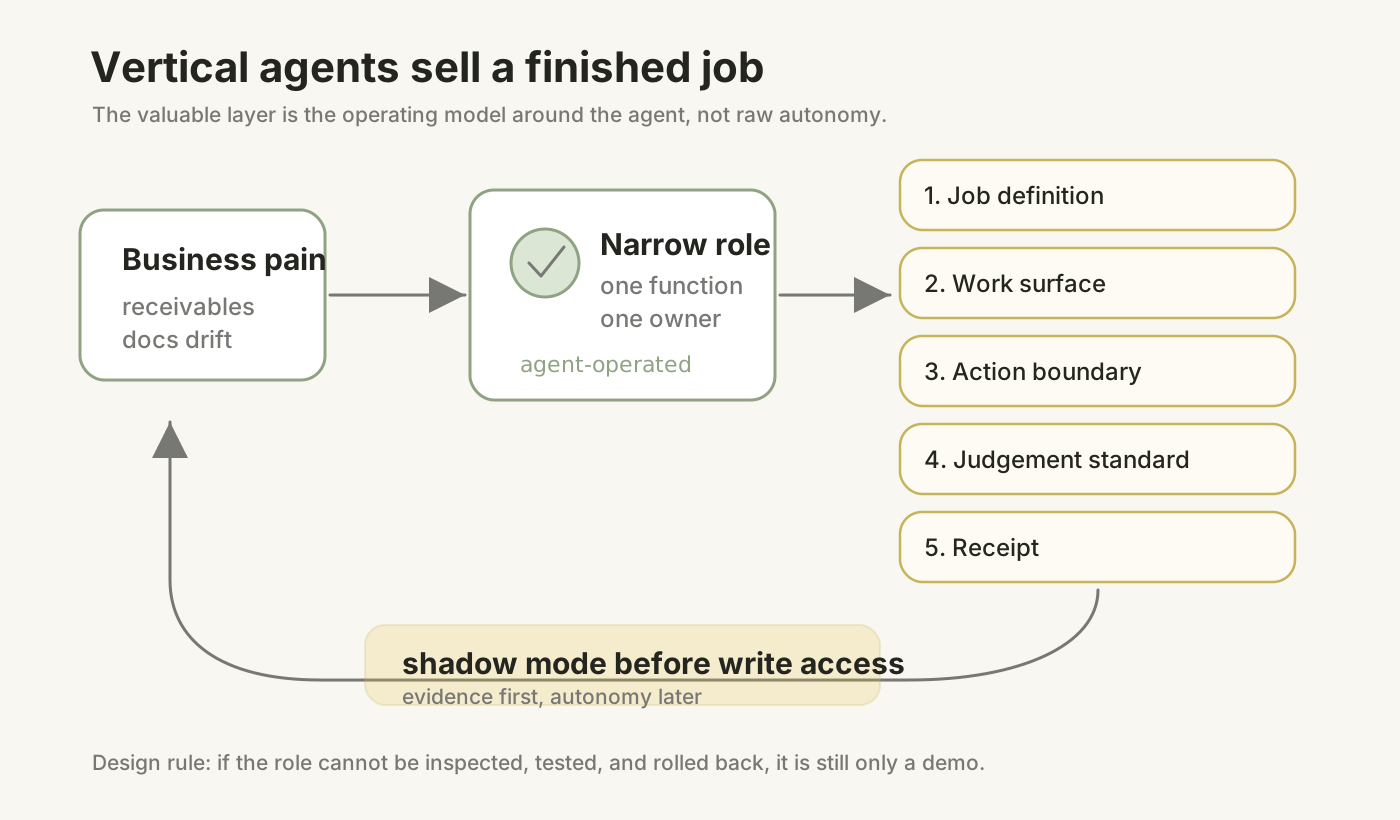
A vertical agent has five parts
A useful vertical agent is not just a model with tools. It needs an operating model around it.
First, the job definition. What outcome is this agent responsible for, and what is explicitly outside scope? “Help with admin” is not a job definition. “Prepare overdue invoice follow-up drafts for approval every weekday morning” is.
Second, the work surface. Which systems does the agent read, and where can it write? Email, CRM, accounting software, GitHub, landing-page CMS, internal docs, support queue, inventory system. The surface must be named because the risk lives in the connection points.
Third, the action boundary. Which operations are automatic, which require approval, and which are forbidden? Reading a customer record is different from updating it. Drafting a payment reminder is different from sending it. Preparing a contract clause is different from inserting it into a live agreement.
Fourth, the judgement standard. What counts as good work? This may be a checklist, rubric, policy reference, test suite, or example set. A code-review agent needs a different standard from a landlord-response agent or a research agent.
Fifth, the receipt. Every serious agent should leave evidence. What did it read? What did it infer? What did it change? What did it refuse to do? Where did a human approve the action?
Without those five parts, the agent remains a demo.
MCP is useful because it can encode the role
MCP keeps appearing in the scouting stream because it gives agents a more standard way to use external tools. That is valuable, but the protocol is not the product.
A badly designed MCP server can still expose the wrong abstraction. If it gives the model raw endpoints, the model has to infer the workflow. If it gives the model a shaped business operation, the organisation can inspect the intention.
The difference is simple. send_email is a dangerous primitive. prepare_overdue_invoice_followup_for_approval is a business role encoded as a tool. It carries the workflow boundary in the name, arguments, policy checks, and output receipt.
That is why the commercial value of MCP is not “we connected your tools to Claude.” The commercial value is that the business function can be packaged as a controlled interface. The agent does not get the company. It gets the part of the company needed to perform one job.
This is also why the current wave of skill generators and MCP tooling is important. Tool creation will get cheaper. The scarce work will move upstream: choosing the right abstraction, deciding the approval boundary, and making the tool legible to both the model and the business owner.
The first Agent Paul offer should be a role sprint
Yesterday’s draft argued for workflow ownership. Today’s stronger formulation is role design.
A workflow ownership sprint takes a messy process and makes it agent-operable. A role sprint goes one step further: it names the agent as a narrow operational role and gives that role its permitted work surface, action boundary, judgement standard, and receipt format.
That may sound like a distinction only a technologist would care about. It is not. It changes the sale.
“AI automation consulting” asks the buyer to imagine a future. “Overdue-invoice follow-up agent, approval-only for the first month, with daily receipts” lets the buyer imagine Monday morning.
The sprint can stay small:
- choose one painful function;
- map the current human process;
- define the narrow agent role;
- connect only the systems needed for that role;
- run in shadow mode;
- review receipts with the business owner;
- promote one safe write action only after evidence exists.
This is practical because it avoids the false choice between toy demos and dangerous autonomy. The agent can be useful before it is fully trusted. Shadow mode produces evidence. Approval gates prevent irreversible mistakes. Receipts convert subjective confidence into inspectable history.
Trust is part of the product, not a compliance afterthought
This connects directly to the Surifi Trust Layer idea. Trust is often treated as something external to the workflow: a badge, score, audit, or review after the work is done. In agent-operated roles, trust has to be built into the doing.
A PR-review agent that leaves no reasoning trail is not trustworthy because it says “approved.” A receivables agent that sends polite but factually wrong emails is not trustworthy because it saved time. A research agent that returns citations without showing selection logic is not trustworthy because the links exist.
The trust layer starts with the role boundary. The agent should know what job it is doing, what evidence it may use, what actions it may take, and what proof it must leave. Then an external appraisal layer can evaluate whether that role was performed properly.
That is a more serious product direction than “agent ratings.” Rate the performance of a bounded role against a known standard. The narrower the role, the more meaningful the trust signal becomes.
Sell the finished job
The near-term agent economy will not be won by whoever says “autonomous” the loudest. It will be won by whoever turns autonomy into a finished job a buyer can understand.
That is good news for Agent Paul Consulting. We do not need to wait for a universal platform. We need a repeatable way to design one agent role at a time, test it without damage, and leave behind a working boundary the buyer can trust.
The pitch is not that the agent is intelligent. The pitch is that the job is now owned.
If we can make that true for one narrow function, we have something a business can buy. If we cannot make it true for one function, the broader promise is theatre.