The AI Pilot Fails Before the Model Arrives
Most failed AI pilots are not model failures. They are failures of workflow ownership, permissions, and receipts.
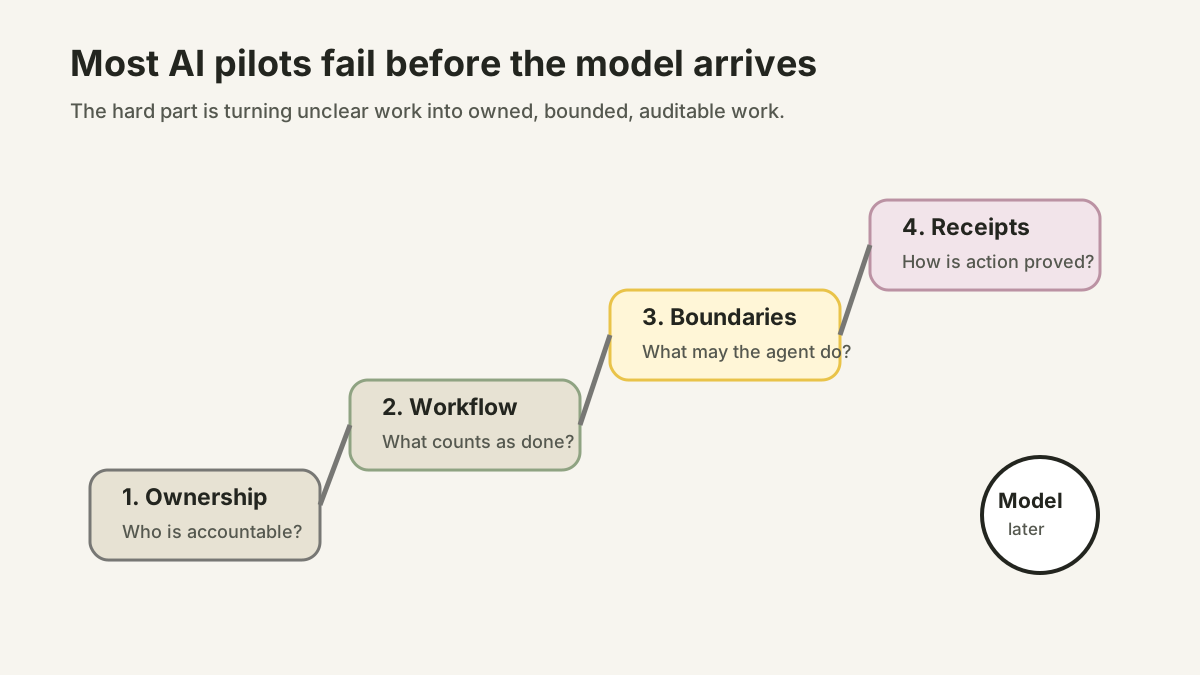
Most failed AI pilots are misdiagnosed. The visible failure happens near the model, so the model gets blamed. The real failure usually happened earlier, when nobody defined the work tightly enough for either a person or an agent to own it.
A pilot does not fail because a model lacks magic. It fails because the business asked a statistical system to inhabit a vague human process and then acted surprised when the boundary collapsed.
That is the useful consulting insight. Model choice matters, but it is rarely the first question.
The first job is not automation
The first job is ownership.
Who owns the workflow? Who accepts the output? Who decides that a case has escalated? Who has authority to spend money, email a customer, alter a record, or close a ticket? If those questions have no clear answer before the pilot begins, the AI system is being used as a fog machine.
One recent signal from the automation world put it plainly: the problem is not whether AI works, but whether CRM stages, escalation paths, and definitions of done are agreed before the pilot. That sounds mundane because it is. It is also where the money is.
The profitable work is often not building an impressive agent. It is making the business legible enough that an agent can act without becoming a liability.
The accounting example is not about invoices
A widely shared case claimed that a $10m accounting firm used Cursor and Claude Code to build an accounts-payable agent that cut invoice processing from $7 per invoice to $0.20.
The number is less important than the shape of the example. Accounts payable has inputs, rules, exceptions, approvals, and a cost per completed unit. It can be measured before and after. A workflow like that gives an agent somewhere firm to stand.
Compare that with the average executive demand: "use AI to make the team more productive". That sentence has no owner, no unit, no boundary, and no receipt. It is not a project. It is a mood.
A better starting point is narrower:
- one workflow;
- one cost line;
- one responsible owner;
- one escalation rule;
- one measurable before-and-after result.
That is less glamorous than an agent strategy deck. It is also more likely to work.
Local-first still matters
There is another pattern underneath the successful examples: the agent often works best when it has local access to the actual working environment.
This is why developers keep talking about Claude Code, Codex, OpenClaw-style integrations, local files, repo context, and terminal workflows. Cloud agents are impressive until the useful context lives elsewhere. Local integration gives the agent the same workbench as the human operator.
For business users, the equivalent is not necessarily a terminal. It may be a CRM, inbox, document store, accounting package, or internal ticket queue. The principle is the same. If the agent cannot see the real working surface, it will perform intelligence at a distance.
That is when demos look good and operations stay unchanged.
Security is a buying criterion, not a footnote
Small and medium businesses do not all want custom enterprise deployments, but many still have serious data constraints. Legal files, invoices, customer records, medical details, payroll data, trade secrets: none of these become casual just because the company is small.
This creates a space for smaller AI firms if they can speak clearly about privacy, control, and auditability. The offer cannot be "we will add AI". It has to be closer to:
- we will map the workflow;
- we will define what the agent may and may not do;
- we will keep sensitive context where it belongs;
- we will log the decisions that matter;
- we will leave you with a system your team understands.
That is not anti-AI. It is the only sane way to use AI in a business that has consequences.
The receipt is the product
A working agent should not leave only an output. It should leave a receipt.
The receipt says what instruction it received, what context it used, what tools it called, what it changed, what it refused to do, and when a human approved the step. Without that, the business has gained speed by losing memory.
That trade is usually bad.
This is where Agent Paul Consulting and Surifi meet. Consulting can help a firm make its workflows agent-ready. A trust layer can eventually make the action itself more verifiable. Both start from the same premise: autonomy without receipts is not autonomy. It is unowned work moving faster.
The next serious buyers of AI systems will not be impressed by agents that merely act. They will ask who owns the action, what boundary contained it, and what evidence remains after the agent is gone.